Article
AI Can Build Websites Fast. That’s Not the Hard Part Anymore
By Keith Mangold · 2026-06-11
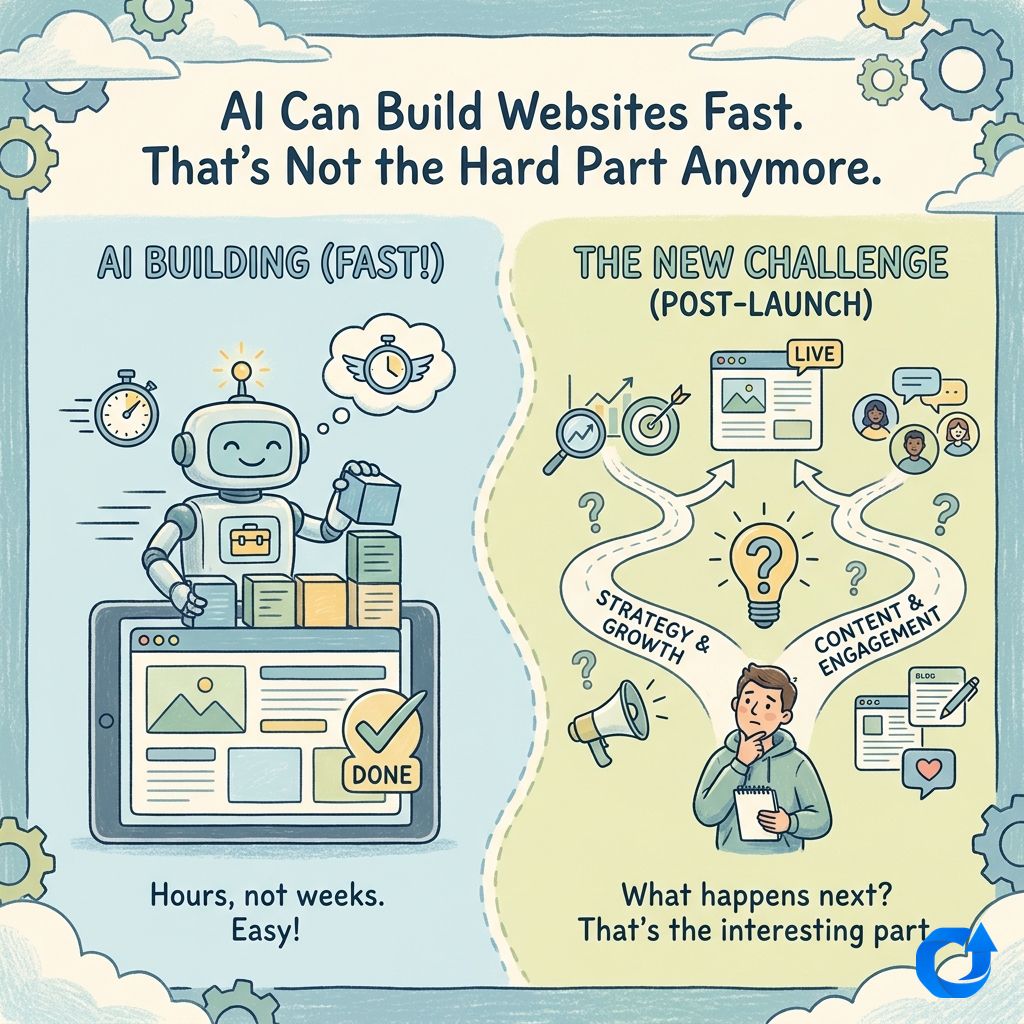
We’ve been experimenting heavily with AI-driven website development lately, and honestly, the surprising part is no longer the speed. At this point, rebuilding a small business website in a matter of hours is becoming fairly normal. We can reorganize content, improve layouts, clean up SEO structure, generate new copy, optimize for mobile devices, and modernize the overall experience dramatically faster than we could even a year ago.
What has become more interesting to us is everything that happens after the website launches.
A recent project made this very obvious. We were helping redesign a website for an adult family home business. The existing website technically worked, but it had many of the same problems we see repeatedly with smaller organizations. Contact information was difficult to find. The site was frustrating on mobile devices. The SEO structure was weak. The photography and layout felt inconsistent. There was very little trust-building content, and almost nothing that explained why someone should choose this business over another nearby option.
The actual redesign process moved quickly. AI helped accelerate almost every part of the work. The harder conversation was deciding what the long-term operating model should look like afterward.
That immediately raised a bunch of practical questions internally. Should we fully host and manage the website ourselves? Should we hand the customer source code and let them figure it out? Should we train them to use AI tools directly? Should the site live on something lightweight like Replit, or should it move into a more traditional development stack? What happens when they accidentally break something? What happens when they need to update photos or text late at night and do not want to wait on a support ticket?
Those questions matter because AI changes more than development speed. AI changes who is capable of participating in maintaining systems.
For years, most small businesses had two frustrating choices. They either became dependent on a web company for every little update, or they tried managing everything themselves through platforms like WordPress, Squarespace, or Wix until the site slowly became outdated and neglected. Neither model worked particularly well.
AI introduces a third possibility. A business owner with almost no technical background can now make meaningful updates simply by describing what they want in plain English. That is a massive shift, and we do not think most people fully appreciate how disruptive that becomes operationally.
At the same time, there is a danger in pretending that AI removes the need for expertise. In many ways, it increases the need for guidance because people are now capable of making large production changes without fully understanding the downstream impact. A website owner might successfully update a homepage banner using AI, but they might also accidentally damage navigation structure, SEO performance, accessibility, or mobile responsiveness without realizing it.
That is why we have been thinking less about “AI website generation” and more about “AI operationalization.”
The generation part is becoming easier every month. Every new model release improves design quality, coding capability, and workflow speed. The harder challenge is building a deployment and maintenance process that works for real people with very different technical skill levels.
Right now, we are experimenting with what feels like a middle-ground approach. We use AI heavily during development because it dramatically improves speed and iteration. However, we also spend time thinking about maintainability, ownership, training, and support boundaries before the project even launches.
For simpler websites, especially informational business sites without heavy backend complexity, platforms like Replit may make a lot of sense. The customer owns the account directly, pays the platform fees themselves, and learns basic maintenance tasks with our help. We can show them how to replace photos, update text, or make small changes safely using AI prompts. More importantly, we can verify that they are comfortable doing those things before we fully hand over the project.
For more advanced systems, we would likely make very different architectural decisions. Some projects eventually outgrow lightweight AI-native platforms and require more traditional engineering approaches involving custom infrastructure, APIs, databases, governance, and security controls. Treating every project the same is a mistake. Some businesses need enterprise-grade architecture. Others simply need a clean, trustworthy website that somebody can realistically maintain without fear.
That distinction is becoming increasingly important because AI is compressing the gap between idea and implementation. Businesses are going to expect digital projects to move faster, cost less, and remain easier to maintain than before. At the same time, they still need guidance around usability, architecture, SEO, accessibility, governance, and long-term sustainability.
We think this creates an interesting shift in the role of digital consulting. The value increasingly comes from helping organizations decide what level of complexity they actually need, what tools fit their operational reality, and how to keep systems maintainable after the excitement of initial deployment wears off.
The future probably is not fully autonomous AI building everything by itself. We also do not think the future is traditional agencies charging hundreds of dollars every time a client needs to replace a photo or edit a sentence.
More likely, the future looks collaborative. Humans still provide judgment, structure, and operational context. AI accelerates implementation and lowers technical barriers. Consultants help establish guardrails, workflows, architecture decisions, and support models that keep the whole thing sustainable over time.
At least from what we are seeing right now, that feels much closer to the real transformation than another headline claiming AI replaced developers overnight.