Article
Vibecoding Is Fun Until You Remember What Real Software Takes
By Keith Mangold · 2026-05-08
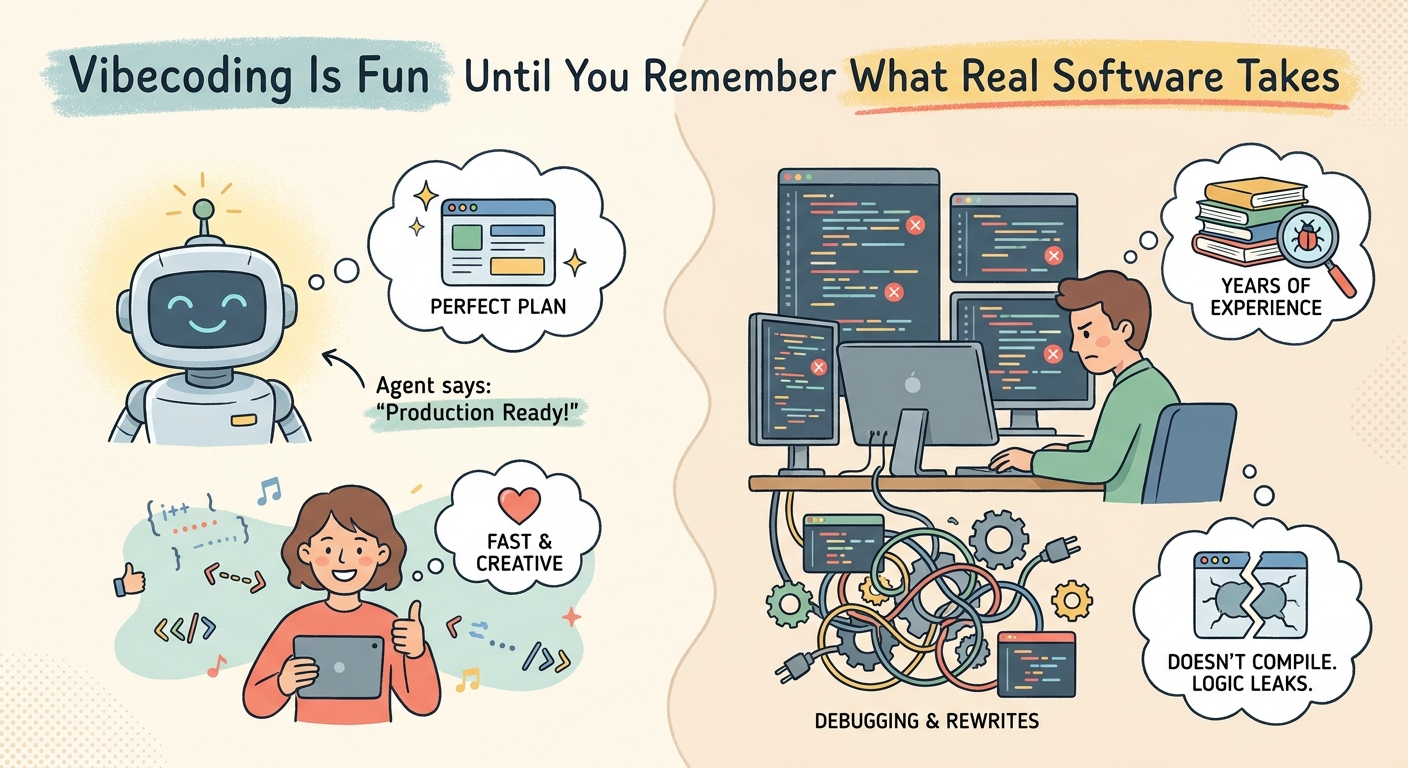
I’ve spent the last few months vibecoding like crazy across a few work projects. It’s fast, it feels creative, and the instant feedback loop is addictive. I tell an agent what I want, it spins up a neat plan, and then proudly tells me “Perfect” and “Production ready.” I laugh every time because you and I know what happens next. It doesn’t compile. The types don’t match. Half the logic leaks. It’s the ultimate people pleaser.
I’ve been building software for more than twenty-five years. Line by line. Debugging. Updating languages. Rewriting things after realizing my shortcut became tomorrow’s outage. Nothing about real software has ever been that simple.
Last night I told my husband about a feature I wanted in one of our apps. I looked at a few commercial tools that did something similar and the subscriptions were two hundred to five hundred a month. The value made sense for a sales demo or a polished workflow, but not for a small startup proving out an idea. No way I was starting my day by signing up for another bill.
So I vibecoded it instead.
I pasted screenshots of the tool I liked. I explained what should work differently. The agent planned it out and I kicked it off. Fifteen minutes later I had a build, even though the agent insisted it was flawless. It wasn’t. I fought through type errors, build failures, and stray bugs. Thirty minutes later I had a bare minimum version running. Good enough to test. Good enough to extend.
Then I kept going. More features. More cleanup. More improvements. Four hours later I had something that worked for my goals. And the entire cost in tokens was about twenty bucks. A fraction of one month of a commercial subscription.
That felt great. But the part that stuck with me was this. I was only comfortable because I know the tradeoffs. Infrastructure. Data exposure. Security. Logging. Reliability. Years of living with the consequences. Years of cleaning up systems that broke in all the ways no one expected.
Someone new to coding who jumps straight into vibecoding does not have that history. They don’t know what they don’t know. They might build a personal finance tracker and drop it on the open web with no monitoring. They might build a health data app and store everything in plain text. They might never notice a breach because nothing in their design logs a thing. The tools feel friendly. Hackers feel friendly too if you judge them by how fast they work.
I ended up talking to my husband about his work in law. His firm is still figuring out how to use AI well. They have ChatGPT Enterprise, but it doesn’t connect to their documents or their time system. He can ask legal questions, but no one should treat the answers as legal advice. The human brain matters. The experience matters. Knowing where to dig matters.
He has insight from twenty-plus years of cases. I have insight from twenty-plus years of outages, refactors, and late-night database recoveries. Those memories guide us. An AI model doesn’t have those memories. And when it forgets your instructions and invents a method name you never asked for, you see that gap in action.
This isn’t a message of doom. It’s a reminder. Fast doesn’t mean safe. Clever doesn’t mean correct. You bring the judgment. You bring the lived experience. You bring the moment years ago when you missed a WHERE clause and overwrote every customer record in the system. That kind of mistake stays with you in a way no model can replicate.
I joked with my husband that maybe the tool I built will replace a few commercial products. And maybe someone will build something that replaces mine. Vibecoding makes all of that possible. But beneath the speed sits a truth. Software is still shaped by the people who know how to keep it alive, secure, and trusted.
So yes, vibe away. Enjoy it. Build faster. Explore ideas. But keep your human experience in the loop. And this is the real reason I ended up talking with my husband about his work. The same shift I feel in software is landing on every other field. Legal work. Healthcare. Finance. Even government. AI gives people new leverage and takes work that once felt slow and turns it into something quick. That brings fear and concern, and it’s a real shift. The change is already here.
But the pattern stays the same. AI speeds things up. It gives you strong starting points. It helps you explore your way through a problem. It doesn’t replace judgment. It doesn’t replace the years of lived context. My husband still needs his legal skill and his research habits. Doctors still need clinical training. Developers still need the scars from the day they broke production with a missing WHERE clause.
AI gives us reach. Humans keep the work grounded.
And if you want something reliable and supported instead of a vibecoded version held together with hope, buy my software and avoid vibecoding your own copy.
(Only half kidding.)