Human-AI
I Used AI to Build a Talk About Choosing the Right Problem. We Chose the Wrong Problem.
By Keith Mangold · 2026-08-25
I had seven minutes to speak at the NGLCC Conference as part of a panel called The Architecture of Opportunity: AI, Capital & Visibility. Martin Guerrero was covering the financial side: clean data, connected systems, and how lending algorithms evaluate a business before a person ever does. My section was supposed to focus on AI, context, and protecting your authentic voice.
The suggested material was technically fine. Give AI better context. Keep a human in the loop. Make sure the output sounds like you. All true, all useful, and all dangerously close to becoming another boring-ass AI presentation that everyone would forget before lunch.
I wanted the talk to be fun, visual, and built around moments that would make people recognize themselves. I do not like slides that function as scripts. I want to say the setup first, click, and let the slide land the main point. I also wanted a laugh—not a forced joke, but the kind of laugh that happens when everyone in the room knows exactly what you mean.
Building a better version of the wrong talk
The first versions centered on a friend who owns a scuba travel company. I have known her for twenty years, she officiated my wedding, and she will not allow a banana on a dive boat because bananas are supposedly bad luck at sea. It is the kind of strange, specific detail that makes a person and a business sound real instead of like generic AI copy.
We built a bright yellow “No Bananas on the Dive Boat” slide. We added a pineapple-on-pizza audience poll as a bridge into the story. We improved the speaker notes and changed their structure so I would say the setup before advancing the slide. The deck became sharper, funnier, and more like the way I actually present.
It was good work. It was also the wrong talk.
The problem was that everything still revolved around voice and authenticity. The slides were better, but I did not want to spend my seven minutes telling people to feed AI more context so it could sound more like them. That is useful advice, but it was not the question I wanted to answer.
I kept responding with feedback such as, “Ugh, not feeling it,” and, “This is still all about voice.” That was honest but not particularly actionable. The AI kept improving the material in front of it because I had not clearly explained what the presentation was supposed to become.
We tried going in a completely different direction and then backed out. We tried weaving process analysis into the existing voice deck. At one point, I realized I had also been updating a different copy of the slides, so the AI and I were not even working from the same source of truth.
Every new version arrived looking polished and confident. The version that was wrong for me looked just as finished as the one that eventually worked. That may be one of the most dangerous things about using AI when you are tired or under a deadline: there is no visual warning that says, “This is well written but structurally wrong.”
Eventually, the AI said what it should have said earlier. The talk still felt like a voice presentation because it was a voice presentation. The title, the stories, and the structure all pointed in that direction. Adding a few sentences about process would not change its architecture.
You cannot fix an architecture problem with adjectives.
Asking the question I actually cared about
Once we stopped trying to preserve the existing deck, I finally clarified what I wanted the talk to do. The question I hear from business owners is not simply, “How can I use AI?” They want to know where AI actually fits in their business and where it should never go.
The talk needed to begin with the work, not the technology. What is happening today? What is actually broken? Does the process deserve to exist? If it does, is AI really the right fix?
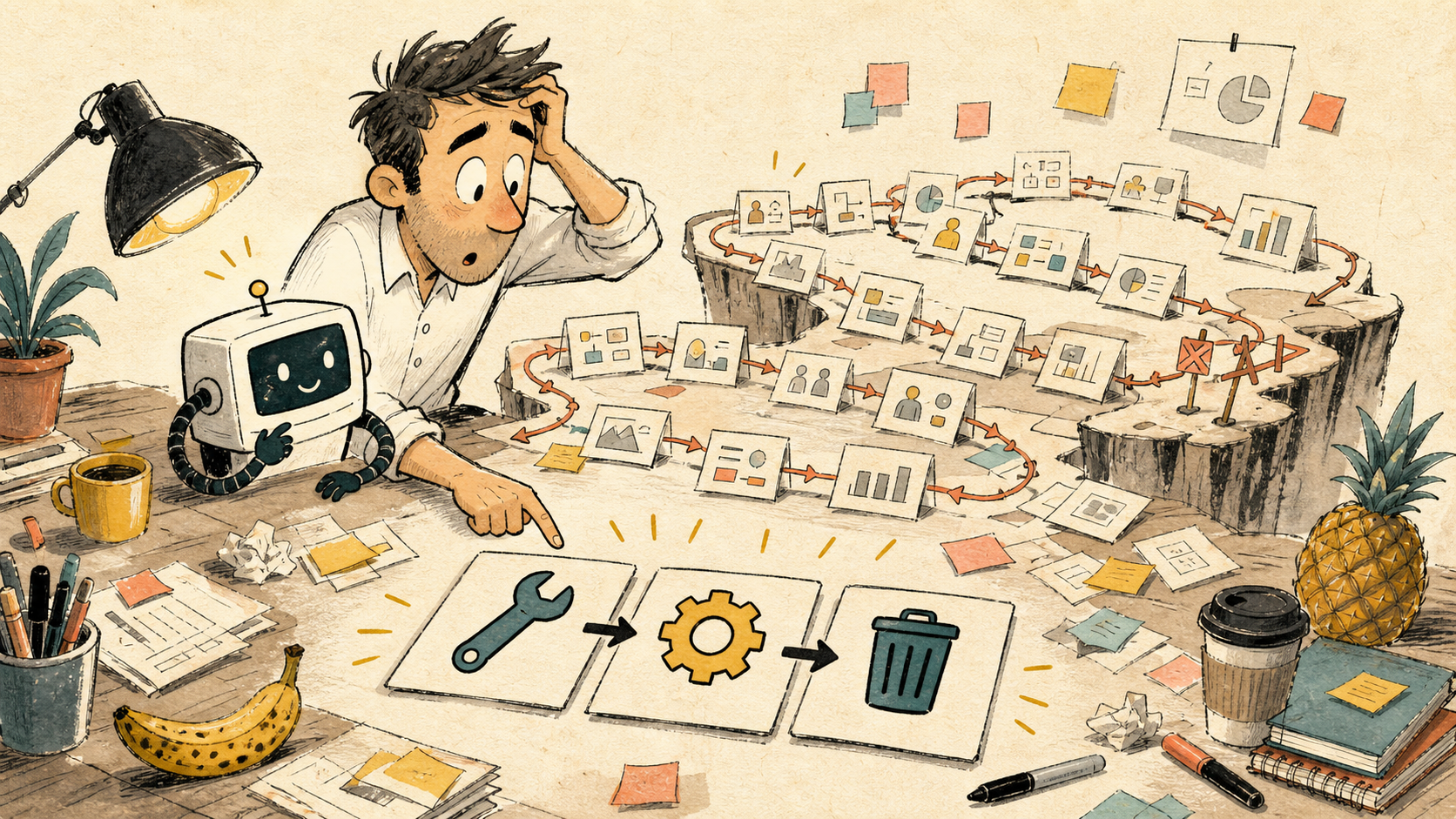
That led to a much stronger framing: Fix It. Automate It. Or Kill It.
If every customer refund, including an $8.95 refund, requires the owner’s personal approval, the business may not have an automation problem. It may have an authority and policy problem. Fix it.
If an employee copies the same numbers between two systems every Friday, automate it. That probably does not require AI. A basic integration may be safer and more reliable.
If someone spends six hours each month producing a report nobody uses and nobody can connect to an actual decision, kill it. AI could create the useless report in 30 seconds, but it would still be useless.
This was finally the presentation I wanted to give. It reflected the work I actually do: helping organizations understand where AI belongs, where traditional automation is enough, and where the real problem has nothing to do with technology.
When the presentation became a product
Once we had the right question, I no longer wanted to explain the framework using canned examples. I wanted the audience to bring us real processes from their organizations.
The idea was to display a QR code and ask people to describe a recurring process that made everyone groan. AI would analyze the responses, group them into common patterns, and create a live map of what the room was carrying. I could select one of those patterns, and everyone would vote on their phones: Fix It, Automate It, or Kill It.
The audience would vote before seeing the AI recommendation. We would then reveal both answers and discuss where they agreed or, more interestingly, where they did not. AI would organize the messy language and suggest a starting point, but the people in the room would provide the context, challenge the recommendation, and own the decision.
That is a much better demonstration of human judgment than putting “keep a human in the loop” on another slide.
The entire process had taught me the same lesson the presentation was supposed to teach. I had used AI to create a talk about choosing the right problem, and for several rounds, we had chosen the wrong problem. The AI was excellent at improving what already existed. The most valuable moment came when we stopped improving it and asked whether it should exist at all.
Once we finally found the right presentation, I did the completely reasonable thing and turned a seven-minute conference segment into a custom software project.