jSwarm Case Studies · Article 02 · Quality
What we mean by “intent” (and why every test and fix starts there)
Written, owner-approved outcomes — Given/When/Then scenarios, non-functional requirements and numbered rulings — bound to every feedback, fix and test, so people decide what “right” means and AI proves it.


Synopsis
A buyer asks, “Did the AI do the right thing?” We can only answer because “right” was written down first. In the jSwarm method that written “right” is called intent: the journey a user needs, Given/When/Then (GWT) scenarios, non-functional requirements, semantic scenarios, and the owner’s numbered decisions. Every test, every fix and every acceptance walk points back at it. jSwarm is the method; JarviSIM is the product we build with it. This article uses real JarviSIM development examples to illustrate jSwarm principles, practices, skills and scripts. It follows one feature from the owner’s words to a judged result, and names the agent responsible at each step. Article 01 showed the AI changing the right thing; this is where “right” comes from.
Audience: AI Solution Product Managers · CIOs and CTOs · AI Developers
The business story
COST
Pay once, not twice
Writing intent is human time well spent. The alternative is paying for the wrong thing and then paying again for the fix.
SPEED
Fewer rework cycles
A clear target means fewer fix cycles that solved the wrong problem.
QUALITY · IN FOCUS · PRODUCT AND DEVELOPMENT
Quality is only measurable against a written target
Here the target is a GWT scenario a person approved. The Agent Acceptance Test (AAT) walk reports every clause of it separately.
Terms used in this article
| Term | In plain English |
|---|---|
| Intent | What “right” looks like, written down and approved by a person before the work is done. |
| Given/When/Then (GWT) scenario | An acceptance test in words: the starting state (Given), the action (When) and every result that must hold (Then). Each of those lines is a GWT clause. |
| AAT and UAT | Agent Acceptance Test (AAT): an agent walks the product step by step and reports, clause by clause, what was met. User Acceptance Test (UAT): a person walks the product and accepts or rejects it. UAT is the final authority. |
more terms
| Term | In plain English |
|---|---|
| jSwarm · JarviSIM | jSwarm is our method: the loop, principles, practices, skills and scripts. JarviSIM is our product. It supplies the real development examples in this article. |
| Non-functional requirement (NFR) | A quality the product must keep whatever the feature: cost, speed, durability — with a written pass/fail rule. |
| Journey | The outcome a user needs end to end, such as “build a process from a document and improve it”. |
| Semantic scenario | Any combination of a structural outcome and a judged quality of the model’s response. Example 1: a chatbot reply plus the model change it makes. Example 2: a user writes their intent in their own terms, and the output must be a valid process model in BPMN (Business Process Model and Notation) that carries the user’s terminology, scope, industry and outcomes. |
| Owner decision | A numbered question with options and trade-offs, closed by the owner in their own words. |
| jTestEngineer | The agent that drafts scenarios and writes tests, and links each test to the intent it proves. |
| jArchitect / jOracle | The agent that writes the fix contract: in plain English, what a correct fix must achieve. |
| jCoder | The agent that changes the code. |
| jQATester | The agent that runs the AAT walk and judges each GWT clause of the scenario. |
| jQAScorer | The agent that grades the model’s responses in semantic scenarios against a frozen rubric. |
/jFeedback · /jFix · /jTest | jSwarm procedures: /jFeedback records feedback and checks it against intent; /jFix takes a fix from intent check to proof; /jTest runs the tests and the walks. |
AI speeds up complex software engineering, but without intent alignment, it will make assumptions and deliver the wrong thing - causing time-consuming, expensive rework.
Intent, tests, code and acceptance line up
Four things must agree. Intent says what right looks like. Tests prove each GWT clause of it. Code is the change under test. Acceptance is the judgment that the clause is met — first by an agent, then by a person.
Kinds of intent
- Journey — the outcome a user needs end to end.
- Given/When/Then scenario — the acceptance test in words.
- Non-functional requirement — a quality to keep, with a pass/fail rule.
- Semantic scenario — a structural outcome plus a judged quality of the model’s response.
- Owner decision — a numbered question closed in the owner’s words.
JarviSIM examples: what they look like
These examples come from JarviSIM, the product we build with the jSwarm method. They show what each kind of intent looks like once it is written down and kept as a record.
Journeys and scenarios are catalogs. The current intent index for this product area lists 33 journeys, 160 GWT scenarios and 74 semantic scenarios (measured, counted in the index). It is regenerated on every change to the backlog. jTestEngineer drafts them; the owner approves them.
A semantic scenario, SS-47. The user accepts a chatbot recommendation with Use this recommendation, then presses Apply. The expected outcome: the product finishes the change and says truthfully whether it did, and nothing changes the model before the user presses Apply. SS-47 links to two GWT scenarios and to three defects with their states: one fixed, one deferred, one registered. It is the conversation behind Article 01.
An owner decision, D282. The chatbot was asked to make several recommendations in one answer. The design that worked end to end needed a second step. That step pushed the first answer past its 55-second limit (measured). The alternative, one call on a stronger model, also broke the limit. The owner’s verdict was “c”: adopt the two-step design now and keep the one-call route as a measured fallback. The decision register holds 282 such decisions (measured, counted in the register), each with the question, the options, the trade-offs and the owner’s verbatim words.
Kinds of tests
- Unit — one piece of code, checked on its own.
- Integration — pieces working together through the real stack.
- Semantic scenario, structural — did the product reach the right state? Deterministic checks.
- Semantic scenario, semantic — was the model’s response right? Graded against a rubric.
JarviSIM examples: intent-to-tests
In JarviSIM the links run both ways: a test names the scenario or requirement it proves, and a scenario lists the tests that prove it. A checker verifies both directions. A test with no intent, or a GWT clause with no test, is a review gap, not a pass.
A GWT scenario and its test. The step-through test for the scenario in this article opens by naming the scenario and the GWT clause each step exercises: build, check the honest not-yet-calculated state, press calculate, reload and read back.
A semantic scenario and its grade. The structural facts — did the model change, did the product reach a truthful terminal — travel with the model’s response, so the grader cannot contradict them. A good grade from jQAScorer never overrides a failed structural check.
Kinds of acceptance
- Agent Acceptance Test (AAT) — jQATester walks the product and reports per clause: met, not met or not exercised.
- User Acceptance Test (UAT) — a person walks the product, gives feedback, and accepts or rejects. UAT is the final authority.
JarviSIM examples: How AAT and UAT work together
Agent Acceptance Testing is agent-judged: a script drives the product step by step and a model judges each step against a written outcome brief, so dozens of walks run between human sessions for cents a walk. User Acceptance Testing is human: the owner walks the product, gives UI/UX feedback, and accepts or rejects. They work together in one loop. Intent is written and approved by people. AAT walks it at volume and reports per clause what was met, not met or not exercised. Fixes follow. UAT accepts. Feedback goes back into intent first.
An AAT walk. In the walk this article follows, jQATester walked the calculate scenario on an earlier build and judged each GWT clause: three met, three not exercised, so the walk is recorded as partial, not as a pass (measured, judged walk record). In another walk, on the scenario that says every task built from a document must show which document it came from, all seven clauses were judged met: jQATester opened each of the nine document-built task pop-ups, reloaded the page, and checked again (measured, walk receipt).
AAT collects its own metrics. Each walk leaves a verdict for every GWT clause (quality) and the time each step took (speed); the AI proxy’s records show what the walk cost. In one JarviSIM test series a typical walk cost about 19 cents (measured). That series launched 68 walks in about 66 hours, up to seven at once, and made 769 clause judgments on 336 steps (measured). You can watch a walk as it runs, and walks run side by side in separate browsers.
A UAT round. In one round the owner walked the current build and wrote their feedback through /jFeedback. The record split it into 11 items and checked each against intent: three were defects against existing GWT clauses, most of the rest were requests no clause covered yet, and one was a question (measured, round record). The round’s verdict was FAIL. The feedback went back into intent first: the owner approved patches to seven existing GWT scenarios — for example, the revision-card scenario now asks for separate ADDED LANES and ADDED TASKS groups, and the reference-content scenario now says what its circled suggestion count means — and three new records were registered, each linked to the scenario it serves. Only then did fixes follow.
How this article walks through it
The loop above is jSwarm’s. To show it at work, we follow one real JarviSIM development example: should the product estimate human effort and AI tokens for every task automatically, or only when the user asks?
Real product example: from the owner’s words to a judged result
These are real JarviSIM development examples, illustrating jSwarm principles, practices, skills and scripts. Every link in the chain is real. The identifiers are the product’s own; they show the records exist. The chain has four stages.
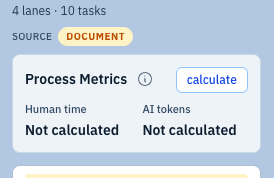
Before calculate
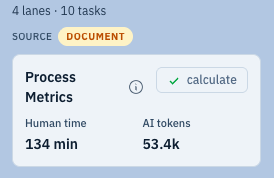
After one press
Record the feedback against intent (
/jFeedback)The owner’s words: “We are taking a multi-prong approach to solving the problem: LLM cache optimization techniques, as well as UX trade-off — creating calculation button instead of doing it automatically, incurring the AI cost when the user wants the information. LLM cache optimization is important, but cannot solve everything.”
The estimates were running after every build and every applied change. Each run cost paid AI calls. The owner decided to pay for the information only when a user asks for it. Why the cost was higher than it should have been is the story of Article 03.
/jFeedbackrecords the feedback and its evidence first. Then it checks each item against existing intent: is there a Given/When/Then (GWT) clause that already covers it, or is this a gap? A gap is written into intent before anyone fixes code. That order matters. A surprise no GWT clause covers can easily lead to gold-plating or over-assurance: extra complexity, cost and maintenance nobody asked for.Here the gap became two pieces of written intent. A non-functional requirement,
NFR-652-13: when the product assesses the same tasks again with nothing changed, its requests to the model must not vary for no reason. And a GWT scenario,UAT-652-CALCULATE-METRICS-ON-DEMAND: the assessments run only when the user presses calculate, and until then each affected task says honestly that its metrics are not yet calculated. jTestEngineer drafted both; the owner approved them.more: what the intent check does
For every layer that applies — acceptance criteria, non-functional requirement, GWT scenario, semantic scenario, journey —
/jFeedbackquotes the covering GWT clause with its identifier, or names the missing or contradictory expectation and the patch it needs. A behavior that breaks an existing clause is a defect against existing intent. A surprise no clause covers is a gap in intent.more: the requirement’s pass/fail rule
NFR-652-13reads “Human-effort and AI-token assessments reuse the LLM cache unless there is a good reason not to.” Its rule: every cache miss for unchanged inputs must have a stated reason. Variation defeats the cache and costs money and time. New requirements are drafted into a proposal, previewed through the real renderer, and committed only after a person approves the preview.more: the scenario in its own words (abridged)
Given a fresh session with an accepted model built through the real document-upload and Build pipeline, with tasks in AI and human lanes.
When the model is built, or a chatbot change that adds or changes a task is applied, and the user then presses the “calculate” button.
Then before Calculate metrics is pressed, the Human-effort and AI-token assessments are not calculated automatically by the build or the Apply. Each task they affect shows an honest not-yet-calculated state (HUMAN EFFORT — Not estimated; AI TOKEN ESTIMATE — Not assessed) on the MODEL REVISIONS card and its node popup. Never “Assessing…”, a stale value from before the change, or an invented number.
Then pressing Calculate metrics does all such metrics calculation and updates the card and the task attributes. The card and the node popup agree, and a reload shows the same values.
Then (fail variants) an assessment still running automatically after a build or Apply, a press that updates only the card or only the task attributes, or a stale value shown as current, is a FAIL.
The scenario names its non-functional requirement (
NFR-652-13) and the five journeys it serves. The owner’s words are embedded in it as a callout, so a reader can see where each clause came from.Write the tests and fix to intent (jTestEngineer,
/jFix, jCoder)The owner’s feedback became five records in the defect backlog: four cost defects and one enhancement. Each one points at the intent it serves.
D1404· Task and lane ids changed with every session, so the same request looked new to the cache.D1405· The document’s internal id changed with every session; same effect.D1406· The build job’s id went into the request; same effect.D1407· A random first-draw value went into the request; same effect.D1408· Replace the automatic assessment with a calculate action, so the AI cost is paid only when the user asks.
/jFixstarts with the same intent check. jArchitect or jOracle then writes the fix contract: in plain English, what a correct fix must achieve, clause by clause. jCoder changes the code. jTestEngineer writes the test steps against the scenario’s GWT clauses, and the links run both ways.more: how a fix stays bound to intent
The intent check comes before diagnosis or dispatch. Every implementation return states “Catalog rows touched/patched” with the scenario identifiers, or “none, with reason”. A fix cannot silently leave intent stale. The enhancement record
D1408links back to the scenario, the non-functional requirement and the estimate conversation (SS-67), and carries its repair and the proof that goes with it. A defect that does not point at intent cannot be judged fixed.more: the test steps, and the links both ways
The step-through test,
calculate-metrics.steps.ts, follows the scenario’s clauses: build; check the honest not-yet-calculated state and the visible button; press calculate; check that the card, the pop-up and the stored task attributes agree; reload and read back. It opens by naming the scenario and the clause each step exercises. In the other direction, a scenario lists the tests that prove it, and a checker verifies both directions. A test without intent, or a GWT clause without a test, is a review gap, not a pass. A functional result that breaks an applicable acceptance criterion or non-functional requirement is incomplete, however green the test.Prove it: the Agent Acceptance Test (AAT) walk (jQATester)
jQATester walked those steps on an earlier build and judged each GWT clause. Three clauses were met. No metrics ran automatically after the build. The calculate button worked on the current revision. After the press, the card, the pop-up and the stored values agreed for all 10 tasks and survived a reload. Parts II and III below show the walk’s own screenshots.
more: the clauses the walk did not reach
Three clauses were not exercised: what happens after a later change to a task, what happens when a calculation fails, and an explicit estimate request through the chatbot. The walk is recorded as partial, not as a pass. That is the point of per-clause reporting: we can say exactly which clauses are proven, instead of “the test passed”.
more: when the grader is wrong, people decide
A later walk graded a renamed task’s neighbors as having “lost” their estimates. Was that the product or the rubric? The owner decided.
D240kept the product behavior and corrected the rubric.D243adopted the corrected wording.D241refused a wholesale re-calibration of the grader every time intent changes, and asked for a targeted second judge instead. jQAScorer grades; people decide what the grader may say.Accept it: User Acceptance Testing (UAT) by the owner
The last stage is human. In UAT the owner walks the product, gives feedback, and accepts or rejects. UAT is the final authority; an agent walk never stands in for it. Whatever the owner finds goes back to stage 1, into intent first.
more: what a UAT round looks like
In one UAT round the owner walked the current build and wrote their feedback through
/jFeedback. The record split it into 11 items and checked each against intent: three were defects against existing GWT clauses, most of the rest were requests no clause covered yet, and one was a question (measured, round record). The round’s verdict was FAIL. The feedback went back into intent first: the owner approved patches to seven existing GWT scenarios, and three new records were registered, each linked to the scenario it serves. Only then did fixes follow. That is UAT doing its job: finding the intent nobody had written down yet.
Where the people are in this chain. People wrote and approved the GWT scenario and the non-functional requirement. People decided what the grading rubric may say. People accept the result in UAT. People feed the next surprise back into intent before anyone touches code. The agents did the walking, the reading-back and the first-pass judging. That is where human judgment goes when AI does the routine work.
Part I
The journey starts with a document.
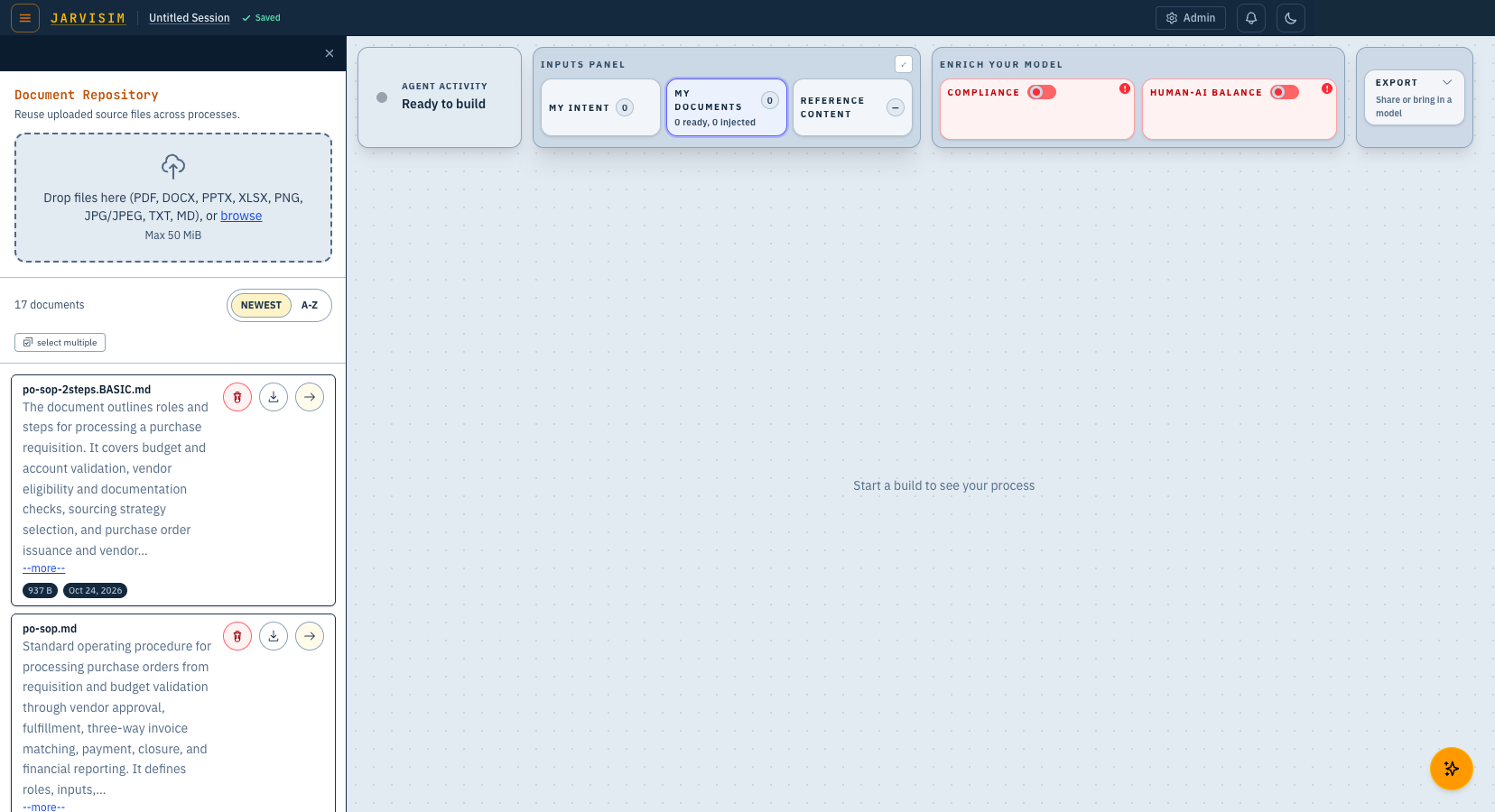
The Given clause asks for a model built from a real uploaded document. This is that screen on the current build: the document library, a Use control for each document, and an empty canvas waiting for a build. Nothing is estimated yet because nothing is built yet.
Part II
Before calculate: honest “not yet”.
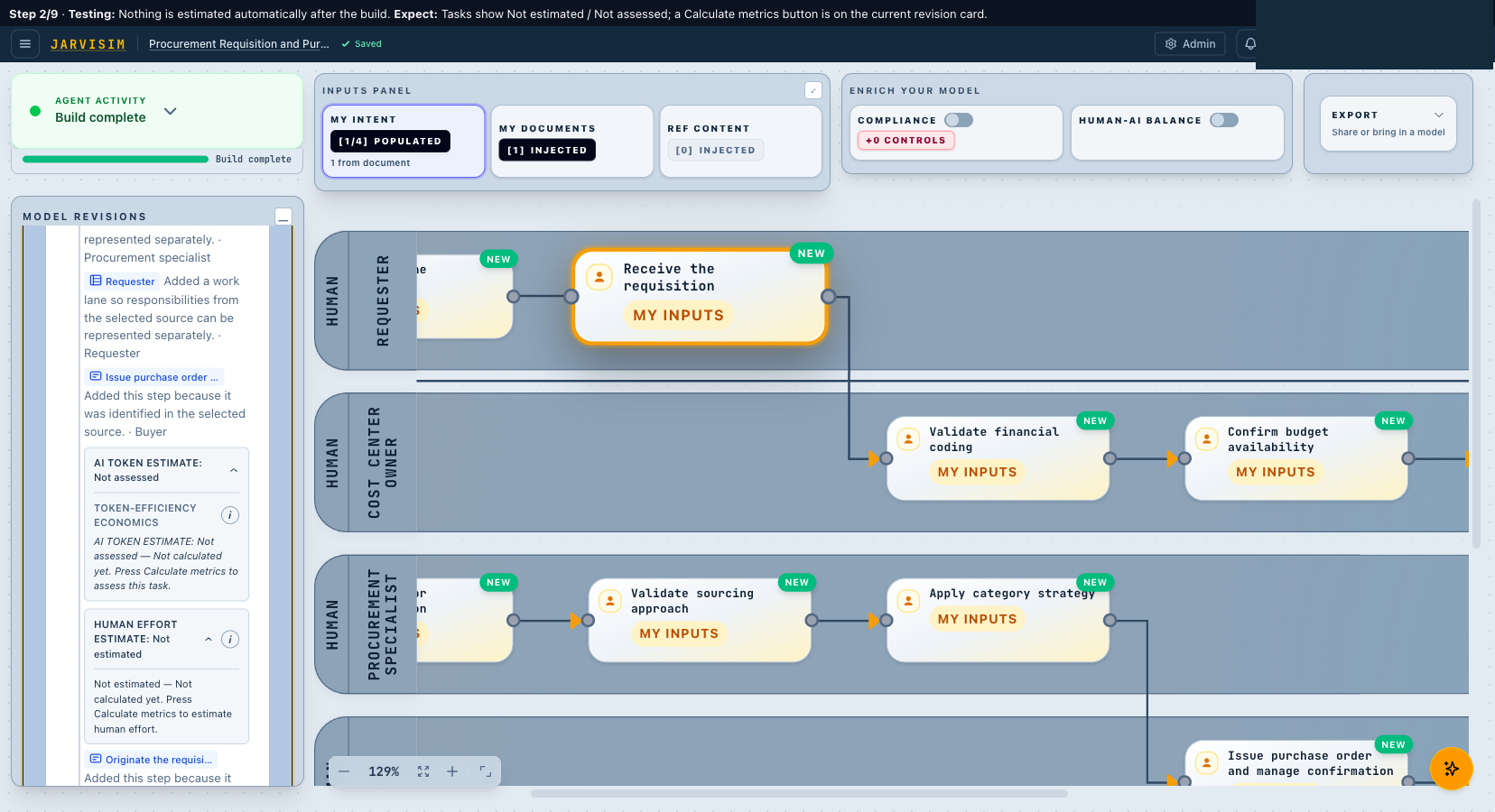
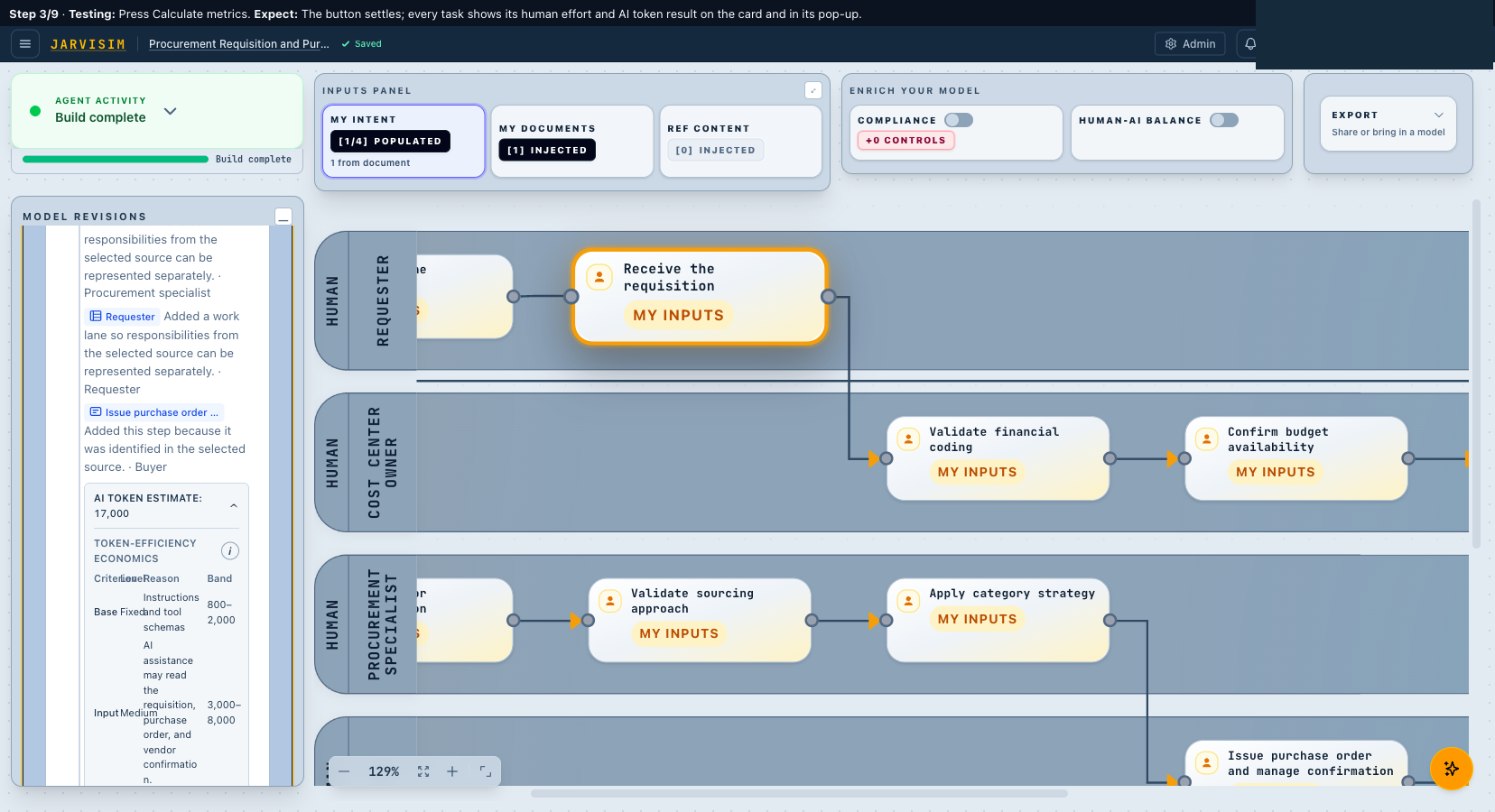
The first Then clause: before calculate is pressed, each affected task shows AI TOKEN ESTIMATE: Not assessed and HUMAN EFFORT ESTIMATE: Not estimated. Never a stale number. This is jQATester’s second step, on an earlier build. The dark bar at the top is the test harness’s own step line, not a JarviSIM feature. It names the clause being checked.
Part III
After calculate: the card, the pop-up and the store agree.
The next step presses calculate. The clause says the card, the task pop-up and the stored values must agree and survive a reload. jQATester read all three and judged the clause met for all 10 tasks. The card now shows AI TOKEN ESTIMATE: 17,000, a displayed product estimate.
Part IV
The same clause on the current build.
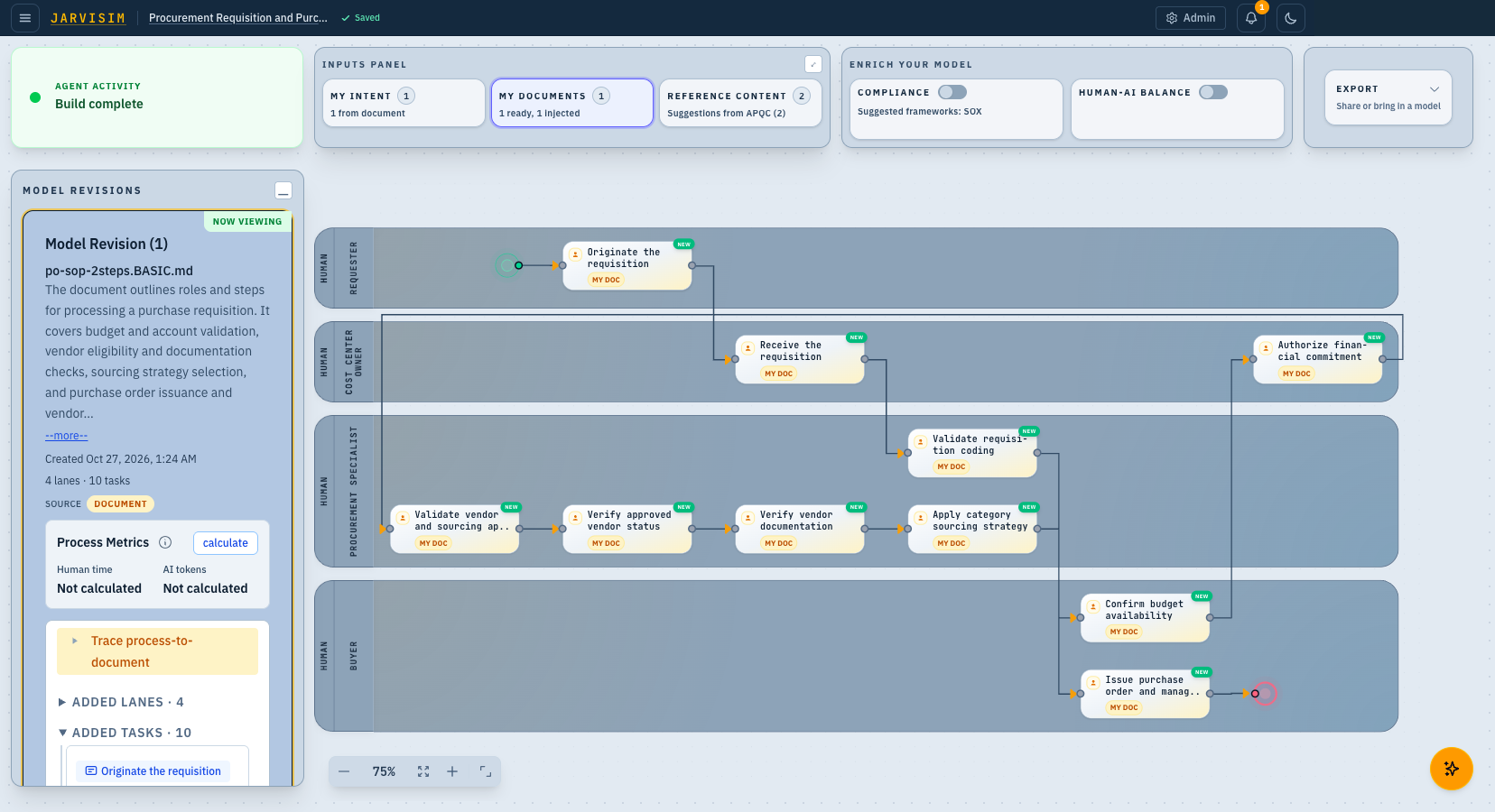
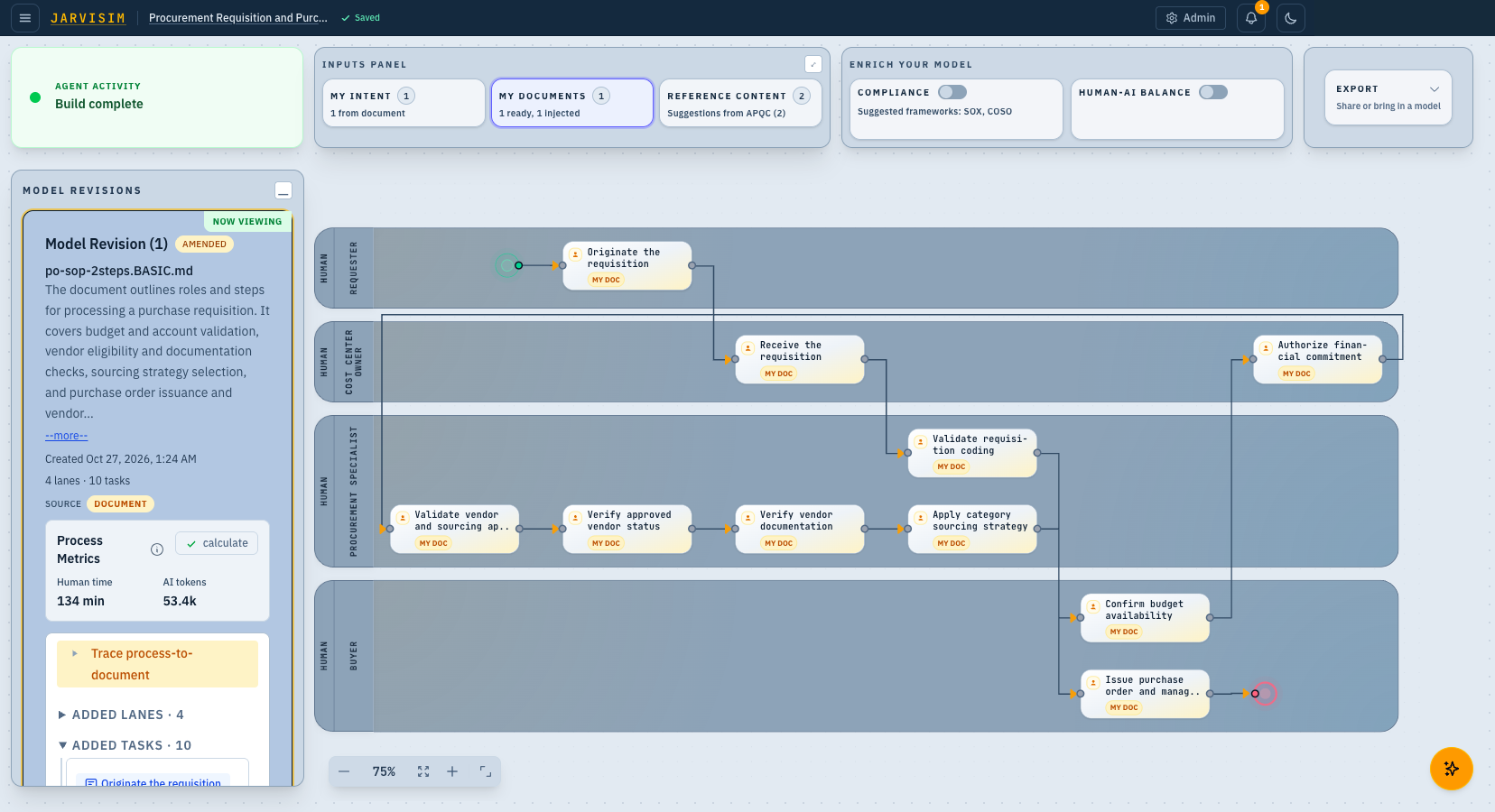
Intent outlives the build it was written for. The current build shows the same honest state before calculate — Process Metrics · Not calculated — and, after one press, Human time 134 min · AI tokens 53.4k for the same ten-task purchasing process. Both are displayed product estimates.
The design lesson
If you cannot write down what right looks like, no test can tell you when you have it.
Screenshot-to-story region map
| Part | In-page enlarged regions | Intent connection |
|---|---|---|
| I | Document repository; the document and its Use control; Ready to build | The Given clause: a model built from a real document |
| II | Test-harness step line; AI TOKEN ESTIMATE · Not assessed; HUMAN EFFORT ESTIMATE · Not estimated | First Then clause; jQATester judged it met |
| III | Test-harness step line; AI TOKEN ESTIMATE · 17,000; token-efficiency reasoning | Second Then clause; jQATester judged it met |
| IV | Process Metrics · Not calculated; Process Metrics · 134 min / 53.4k; the ten-task process; Model Revision (1) counts | The same clauses on the current build |
For Claude Certified Architect–Professional readers
Anthropic’s guidance on defining success criteria and building evaluations asks for criteria that are specific and measurable before you build the evaluation. We apply this on a real product. Our Given/When/Then scenarios and non-functional requirements are those criteria, written by people and approved by the owner. The test steps and the AAT walk are the evaluation, linked back to each clause with a per-clause verdict.
CCA-P connections: Evaluation, Testing & Optimization through measurable acceptance clauses; Governance, Safety & Risk Management through owner approval and human acceptance; Stakeholder Communication & Lifecycle Management through recorded decisions and feedback; and Developer Productivity & Operational Enablement through agent test and fix workflows. The walk metrics describe the reported test series, not a measured reduction in delivery cost or time.